

They make it hard for you to get paid.
Let's put an end to that.
The problem

The work was done. The patient is happy. And now your team spends an hour on the phone trying to get the claim paid.
Then there’s the claims that were submitted and somehow “never arrived.” The same questions asked four different ways across three phone calls. The denials that make no sense. The crowns paid as fillings. The procedures bundled into one payment that covers neither of them. The appeals you have to file to collect money you already earned.
And underneath all of that, the things you rarely see. The denials that came in and got filed away because nobody had time to fight them. The payments that arrived and were never posted. The claims that went out missing an x-ray or narrative that turned a ten day easy payment into a five week battle.
The stress. The headaches. The time spent by your team dealing with insurance companies instead of helping to take care of your patients.
And in the end, when these claims aren’t paid, the result is the same. Your money, sitting somewhere else other than your practice.
Why they get away with it
Because they can. Getting paid by insurance companies was always a little complex. And over time it has only become more difficult and harder to understand. Most likely that was intentional. And the problems are not only confined to large claims for major services.
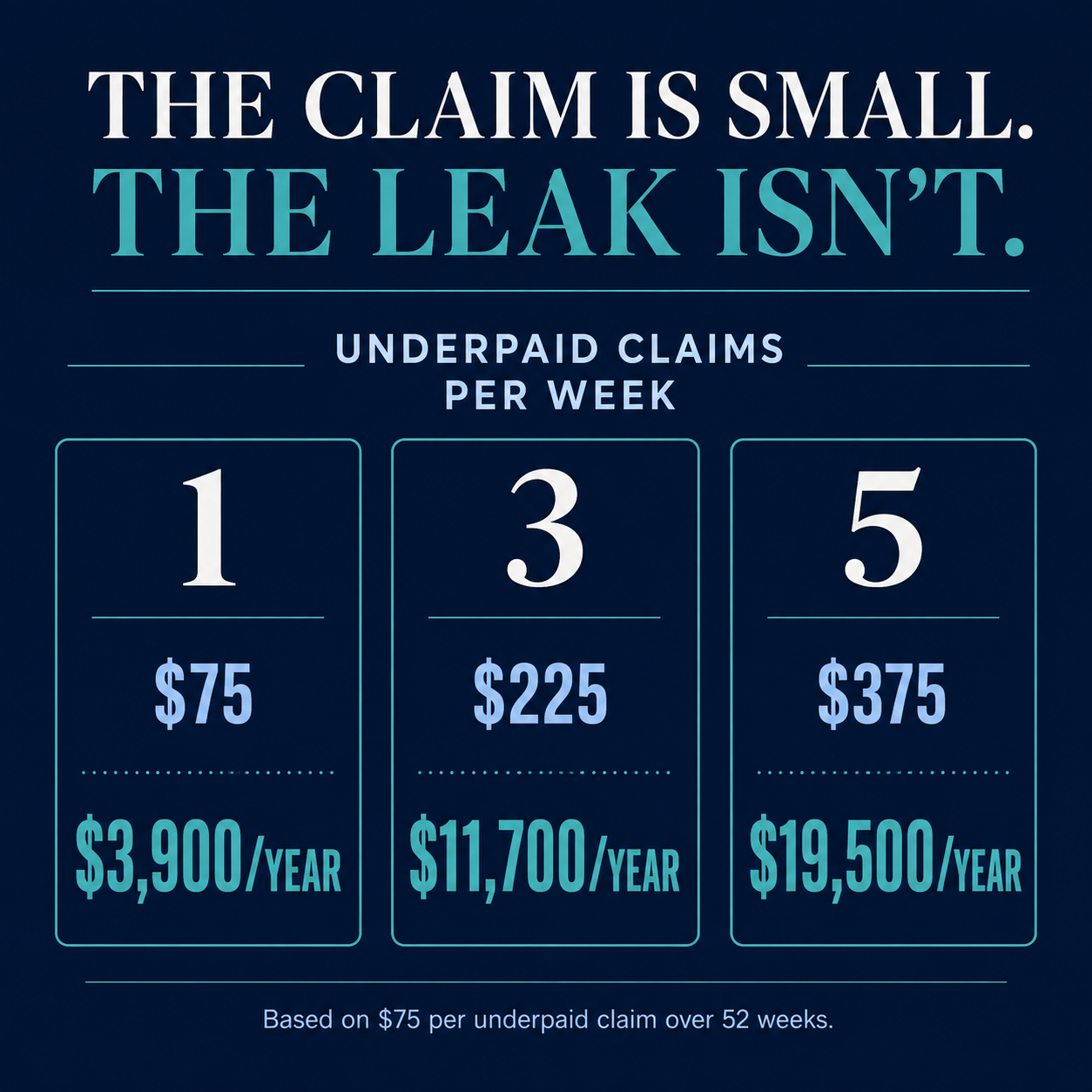
Case in point. A claim comes back seventy-five dollars short. To recover it, somebody has to sit on hold, work out what happened, file the appeal, and follow it up. Call it forty minutes. That person costs you twenty-five or thirty dollars an hour, and they have a schedule to fill and patients to take care of.
So the math says let it go. And it is the right call, in isolation, every single time.
And it is things like this that the insurance companies are counting on. Not on being right. On the claim being small enough that fighting it costs more than winning it. Multiply it across a year and the number stops being small, but no individual claim ever feels worth the fight.
We are set up the other way around. Working that claim is not something we squeeze between patients. It’s our job.
How we handle insurance billing

Claims go out daily, straight from your practice management software, and every one gets checked for what it needs before it goes. X-rays, narratives, periodontal charting, clinical documentation. A claim missing its supporting record is a denial waiting to happen, and catching it before submission is most of the difference between filing claims and getting paid for them.
Payments get posted daily with the EOB documentation attached and the contractual adjustments entered.
Rejections get corrected and resubmitted by us. They do not come back to your front desk as homework. Denied claims get investigated and resubmitted. Downcoding and bundling get appealed. You do not have to notice it, flag it, or ask.
And nobody writes anything off without your approval. That is your money and your decision.
See if we can help.
Let us deal with the insurance companies. Your team can focus on patients.
What to expect
You See the Work
A daily report, updated as the work happens. Claims submitted and the dollar amount. Payments posted and the dollar amount. Your insurance aging buckets are reported every Friday.
Regular contact with your account manager on a schedule you set. Weekly at the start, then every other week or monthly once things are running.
Your Money, Your Decision
No write-offs without your approval.
Not a courtesy adjustment, not a cleanup. Nothing. If a balance needs an adjustment, we bring it to you first and you decide.
That's your money and your decision.
We Also Teach
In addition to providing billing services, we also show your team how to make things easier and more efficient in the practice. When your team understands how a patient's insurance works, and can explain it to a patient, they provide better customer service and present treatment with confidence.
More visibility. More control. A knowledgeable team.
If I become a client, what does my office still do?
You create the claim, which takes a minute or two. That is it. Attachments, submission, rejections, follow-up, appeals, and posting are all ours.
Is there a claim too small for you to chase?
No. That is the whole point. While the big concern for one and all is usually the larger claims, these small claims can really add up! A seventy-five dollar underpayment is not worth your team's time, but it is worth ours, because working claims is what we do all day rather than something we have to handle while working with patients.
Why do you tell clients to stop taking virtual credit cards?
Because they cost you money you already earned. When a payer sends a virtual credit card instead of an electronic funds transfer, you run it like any other card and pay a processing fee on the payment. And to add insult to injury, this might have been for an amount that was already reduced by your contracted discount!
Here is the part most offices do not know. You do not have to accept them. The Centers for Medicare and Medicaid Services, (CMS) issued guidance on electronic payments that applies across health plans, not just Medicare and Medicaid. CMS guidance is clear that a health plan cannot require a provider to take virtual credit card payments, and that you can request the standard electronic funds transfer instead. If you ask, the plan has to comply.
We’ll post them for you either way, but we would rather you stopped losing money by getting them, so we will tell you which of your payers are doing it and walk you through opting out.
The specific guidance on this from CMS can be found here.
What happens when a claim is denied?
We investigate the reason, correct whatever caused it, and resubmit. If it should have been covered, we appeal. You do not have to tell us to chase it, it’s part of our job.
What if insurance downcodes or bundles a procedure?
We appeal it. The most common version is a crown paid as a filling. We catch it and fight it without waiting for the office to spot it on a report
How do payments actually get posted?
Three ways, depending on how the money arrives.
For electronic funds transfers, your account manager logs into the account daily, identifies the insurance deposits, pulls the corresponding EOB, posts the payment, uploads the EOB to the patient account, and enters the contractual adjustments.
For virtual credit cards, your office forwards us the card information and we post the payment, enter the adjustments, and upload the documentation.
For paper checks, your office scans them into a designated folder and we process them by the end of the next business day.
Questions?
Still have a question? Call (800) 677-7142 or book a consult.
How do I get started?
Book a consult with one of our billing specialists. We will find out what you need help with and what you are hoping to achieve. And if we are a fit, we will walk you through exactly what we would do, what it costs, and what you can expect.
You will get a straight answer, including if the answer is no.